At Full Function Chiropractic, we always strive to provide our patients with up-to-date, conservative therapy and treatment options. To this end, we are excited to offer Red and Near-Infrared Light Therapy.
What is Red Light Therapy?
Red light therapy (RLT) utilizes LED lights to harness the healing power of the sun, specifically in the red and near-infrared (NIR) wavelengths, to promote cellular health.
How It Works:
RLT works on the principle of photobiomodulation. Red and NIR light are readily absorbed by photoreceptors in our cells called Cytochrome C-Oxidase. When stimulated, these receptors activate the powerhouses of our cells, mitochondria. Mitochondria produce ATP, which is the main energy source for cellular activity in our bodies. Increased energy means increased cellular efficiency, function, and overall well-being.

What are the Benefits of RLT?
- Reduces Joint Pain and Inflammation
- Promotes Collagen Production
- Improves Skin Health
- Reduces Oxidative Stress
- Speeds Muscle Recovery
- Facilitates Weight Loss
- Facilitates Hair Growth
- Improves Circulation

Is Red Light Therapy the Same as Cold Laser Therapy?
While RLT is often referred to as Low Level Laser Therapy, and operates on the same principal of photobiomodulation, they are clinically different. Both therapies utilize specific wavelengths, designed to stimulate cellular activity, however, the way in which the light is generated differs considerably. Laser beams are generated by exciting electrons to travel in a very straight, and coherent path. Red Light Therapy is generated using LED light bulbs, which create a light that is more scattered, incoherent, and typically has a lower power output. This difference allows laser therapy to penetrate deeper, be focused to a specific injury site, and be performed in a much shorter period of time.
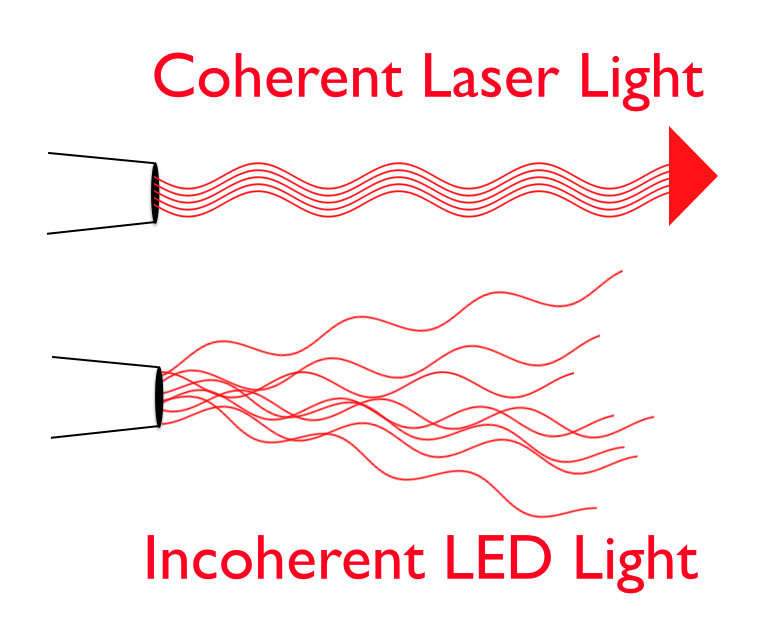
An easy analogy is to think of Red Light Therapy as rain, while Laser Therapy is a hose. Both provide essential water to your plants, but one allows you to do so in a much more targeted and accelerated fashion.
In Summary, RLT is the best choice when pursuing general wellness, or when trying to support a more generalized issue. Cold Laser Therapy (coupled with chiropractic care) is the best choice when treating a specific injury, such as an ankle sprain, biceps strain, etc.
Is Red Light Therapy Safe?
According to the Cleveland Clinic, “red light therapy appears to be safe and is not associated with any side effects, at least if used short-term and as directed. This therapy is not toxic, not invasive and not as harsh as some topical skin treatments.”
RLT does not use ultraviolet (UV) light, and therefore, does not pose the same risks associated with tanning beds or prolonged sun exposure.
A 2023 systematic review, published in the Aesthetic Surgery Journal, also found that “current clinical and preclinical evidence suggests that (photobiomodulation) is oncologically safe for skin rejuvenation, and there is no evidence to support the proposition that it should be avoided by patients who have previously undergone treatment for cancer.
How Often Should I Have RLT?
While the number of recommended sessions varies person to person, and is influenced by multiple factors (e.g. amount of skin exposed, your unique physiology, skin tone, etc.), the average recommendation is 3x/wk. for the first few weeks. Of course, this is also influenced by how long you have been experiencing the issue at hand, and what your long-term goals are. A lower freq. may be more appropriate if you are simply looking to recover from a specific event (e.g. 5K, golf tournament, or school finals) or just looking for a day of relaxation.
How Long is a Typical RLT Session?
The average session takes just 20 minutes, with 10 minutes of light exposure to your front, and 10 minutes of exposure to your back.
How Much Does it Cost?
| # of Sessions Purchased | Cost/Session | Total Cost | Savings |
| 1 | $40 | $40 | – |
| 3 | $35 | $105 | $15 |
| 4 | $30 | $120 | $40 |
| 8 | $25 | $200 | $120 |
| 12 | $20 | $240 | $240 |
What the Research Says…
- A 2015 meta-analysis found that “phototherapy (with lasers and LEDs) improves muscular performance and accelerates recovery mainly when applied before exercise.” Specifically, “the time until exhaustion increased significantly compared to placebo by 4.12 s and the number of repetitions increased by 5.47… most significant and consistent results were found with red or infrared wavelengths.”
- Leal-Junior EC, Vanin AA, Miranda EF, de Carvalho Pde T, Dal Corso S, Bjordal JM. Effect of phototherapy (low-level laser therapy and light-emitting diode therapy) on exercise performance and markers of exercise recovery: a systematic review with meta-analysis. Lasers Med Sci. 2015 Feb;30(2):925-39. doi: 10.1007/s10103-013-1465-4. Epub 2013 Nov 19. PMID: 24249354.
- A 2023 study found that “improved self-reported sleep, as well as perceived improvements in relaxation and mood, were observed among active (red light and near-infrared light users) but not sham users.”
- Kennedy KER, Wills CCA, Holt C, Grandner MA. A randomized, sham-controlled trial of a novel near-infrared phototherapy device on sleep and daytime function. J Clin Sleep Med. 2023 May 4. doi: 10.5664/jcsm.10648. Epub ahead of print. PMID: 37141002.
- A 2022 systemic review was performed “to assess the curative effect of photobiomodulation therapy for the treatment of hair loss… the study found that infrared light (was) effective for treating alopecia areata, and photobiomodulation therapies with red light and infrared light were effective for treating androgenetic alopecia. All meta-analyses showed that treatments were superior to control.
- Zhang Y, Su J, Ma K, Fu X, Zhang C. Photobiomodulation Therapy With Different Wavebands for Hair Loss: A Systematic Review and Meta-Analysis. Dermatol Surg. 2022 Jul 1;48(7):737-740. doi: 10.1097/DSS.0000000000003472. Epub 2022 Apr 25. PMID: 35510860.
- A 2021 meta-analysis on tendinopathies found that “when photobiomodulation plus exercise was compared to sham treatment plus exercise, PBM demonstrated greater decreases in pain and improved function.”
- Tripodi N, Feehan J, Husaric M, Sidiroglou F, Apostolopoulos V. The effect of low-level red and near-infrared photobiomodulation on pain and function in tendinopathy: a systematic review and meta-analysis of randomized control trials. BMC Sports Sci Med Rehabil. 2021 Aug 14;13(1):91. doi: 10.1186/s13102-021-00306-z. PMID: 34391447; PMCID: PMC8364035.
- Glass GE. Photobiomodulation: A Systematic Review of the Oncologic Safety of Low-Level Light Therapy for Aesthetic Skin Rejuvenation. Aesthet Surg J. 2023 Apr 10;43(5):NP357-NP371. doi: 10.1093/asj/sjad018. PMID: 36722207.
 Full Function Chiropractic